
Bathrooms and wet areas
In a humid climate the bathroom is the most demanding room in the house. We build wet areas that survive the rainy season without mould, odours or tiles letting go.

Nine out of ten "fix what someone else built" calls in Phuket start with a bathroom: mould in the corners, a drain smell, a leak into the neighbour's ceiling. The cause is always the same — broken technology in the hidden layers. A humid climate does not forgive a skipped primer or waterproofing "only inside the shower".
We build wet areas to a specification refined over years of working in Thailand: waterproofing across the whole floor and up the walls, a mandatory 24-hour flood test, supply-and-extract ventilation sized by air-change calculation, falls checked with a level — not by eye.
We take on single bathrooms in occupied homes as well as every wet area of a full renovation: master bathrooms, guest WCs, laundries, outdoor pool showers, hammams.
Methods of execution
A bathroom's quality is decided before the first tile goes down. Most of our specification concerns layers you will never see in the finished room.
- 01
Waterproofing with a flood test
Two-component cement-polymer membrane across the entire floor, 300 mm up every wall and to the ceiling inside showers. Before tiling we flood the floor for 24 hours and inspect the slab from below.
- 02
Falls and drains
Screed laid to 1–2% falls, linear drains with dry traps — water leaves completely, so odours have nowhere to come from. We check every metre with a level.
- 03
Calculated ventilation
The extract fan is sized to the room volume and runs off a humidity sensor, not the light switch. Make-up air comes through transfer grilles. That is the whole answer to "why don't your bathrooms grow mould".
- 04
Stone and large-format tiling
Tile and stone go down on C2S1-class adhesive, back-buttered, with epoxy grout in wet zones. Large-format porcelain is cut and edged on our own bench.
- 05
Sanitaryware and final tuning
We install and tune mixers, rain showers and concealed cisterns, then verify pressure, temperature and the operation of every fixture at handover — together with you.
Examples of work
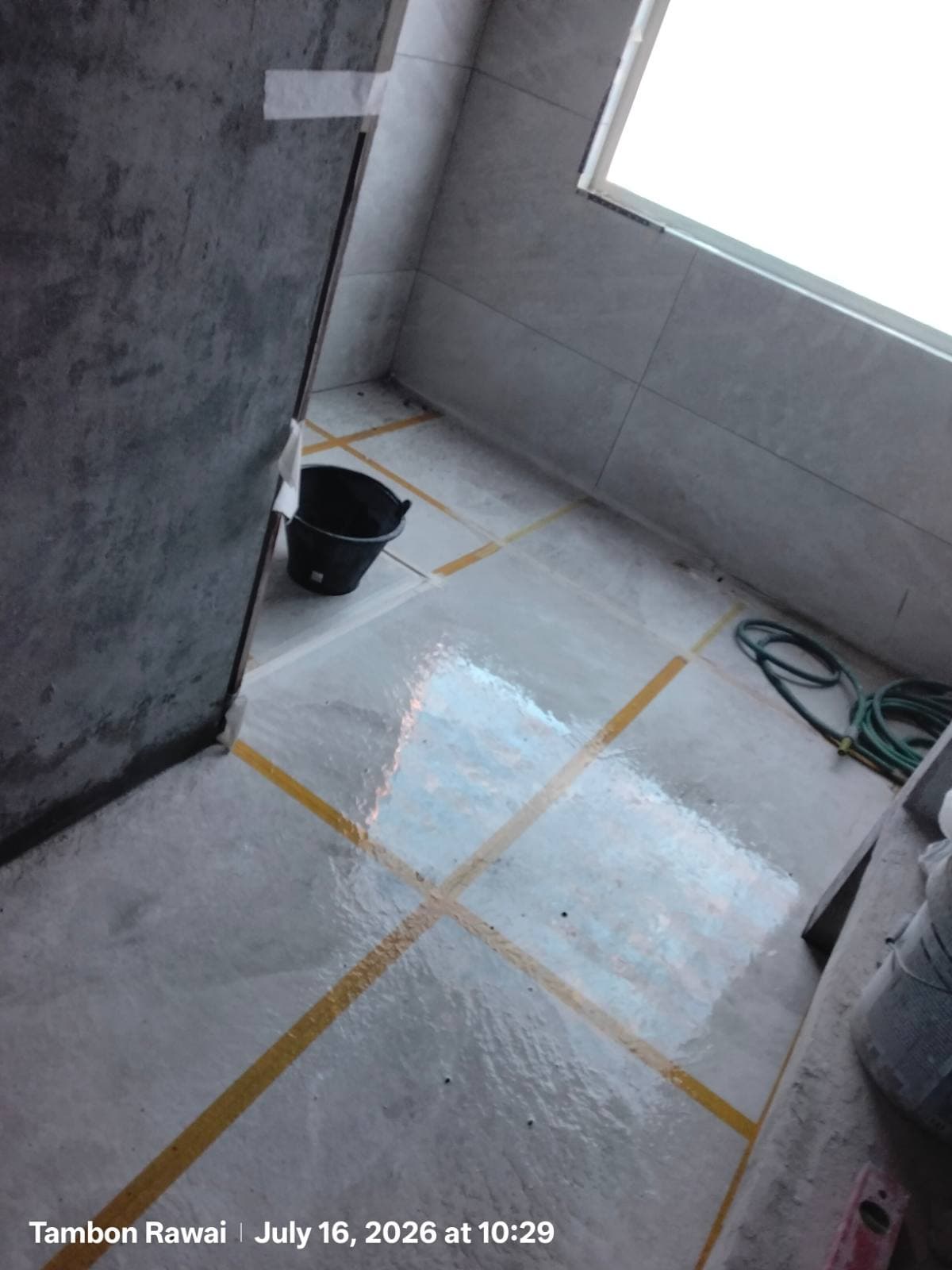

Our approach
Concealed work in a bathroom is accepted by technical supervision, not by the crew that did it: waterproofing, water and drainage runs, tile substrate. Every stage is photographed into the project's digital dashboard — three years later you can show a plumber exactly where the pipe runs.
Wet-area materials are the one category where we refuse to substitute cheaper "equivalents", even at a client's request. The price difference between right and wrong waterproofing is about 2% of a bathroom budget; the difference in consequences is redoing the bathroom and the neighbour's ceiling.
Every bathroom carries a 12-month warranty on the works and three years on the integrity of the waterproofing envelope. We can offer that only because we control every layer.
Who works on your project
Wet areas are built by a dedicated unit — the same people from project to project: a tiler, a plumber and a waterproofing specialist who have worked together for years.
Waterproofing specialist
Owns the envelope: substrate preparation, two coats with reinforced corners, the flood test.
Plumber
Water and drainage runs, falls, installation and tuning of fixtures. Every loop pressure-tested.
Tiler
Large format, natural stone, mosaic. Cutting and edging on our own bench.
Scope of work
- Strip-out of old finishes
- Perimeter waterproofing
- Water and drainage runs
- Screeds with falls, drains
- Wet-area ventilation
- Tile and stone installation
- Sanitaryware installation and tuning
- Sealing and final checks
Ready to discuss your property?
Tell us about the task — we'll come back with a preliminary estimate and a plan for the first step.